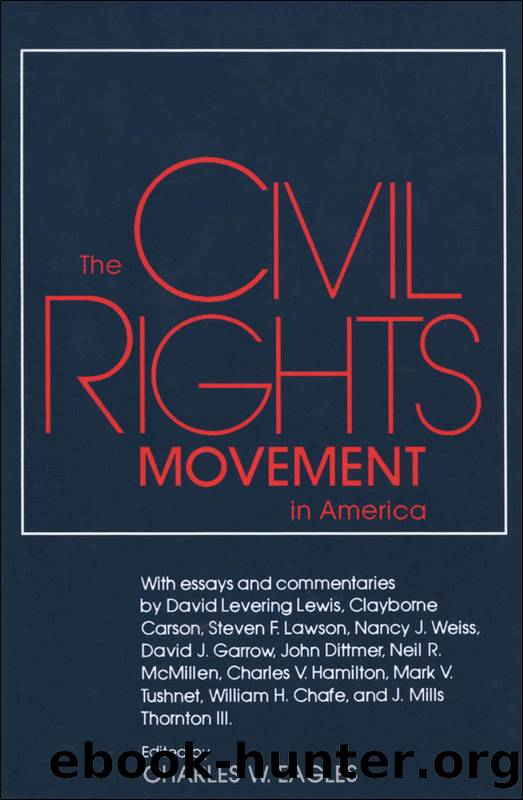
The Civil Rights Movement in America by Charles W. Eagles
Author:Charles W. Eagles
Language: eng
Format: epub
Publisher: University Press of Mississippi
Published: 1986-01-15T00:00:00+00:00
Federal Law and the Courts in the Civil Rights Movement
CHARLES V. HAMILTON
What came to be known in the United States as the civil rights movementâfrom the early 20th century to the late 1960sâwas first and foremost a movement to end de jure segregation in the country. Let this presentation begin with an unambiguous conclusion: that movement was successful. Blatant, overt laws requiring segregation of the races were declared unconstitutional, and laws denying and impeding the right of black Americans to vote were ended. In this sense, the civil rights movement that most people joined (or opposed) was won.
To be sure, there were always efforts at overcoming de facto segregation and discrimination. And equally clear, these efforts continue, but the first, fundamental goal of the civil rights movementâto square the statutes with the constitutionâwas achieved. Segregation effects and discriminatory practices remain, but this is the next, important phase of the struggleâCivil Rights II, if you will. But Civil Rights I is over, and it was successful.
This paper will focus on the role of the federal courts and federal laws in achieving that momentous victory. It will address the following proposition:
Changes in the civil rights of blacks resulted not just from protests and demonstrations carried out by individuals and organizations at the local level, but also from laws implemented by Congress and from the actions of federal judges.
The intent of this paper is to analyze the approach and impact of court decisions and laws. It is organized in four parts. First, the necessity and rationale for a judicio-legislative strategy. Second, the evolution of that strategy, covering voting rights cases, education, public accommodations, and the civil rights and voting rights laws. Here it will discuss the courtsâ willingness to overrule the efforts of subterfuge practiced by local segregationists. Third, the inter-relationship of laws and protests. Fourth, a concluding section discussing the movement from ârights to resources,â and the issues law and courts will be called upon to address. Dealing with the last set of problems will point out the differences between the earlier civil rights movement and the current phase, as well as the limitations of and opportunities for a judicio-legislative strategy.
Download
This site does not store any files on its server. We only index and link to content provided by other sites. Please contact the content providers to delete copyright contents if any and email us, we'll remove relevant links or contents immediately.
Cecilia; Or, Memoirs of an Heiress — Volume 1 by Fanny Burney(32527)
Cecilia; Or, Memoirs of an Heiress — Volume 2 by Fanny Burney(31928)
Cecilia; Or, Memoirs of an Heiress — Volume 3 by Fanny Burney(31916)
The Great Music City by Andrea Baker(31902)
We're Going to Need More Wine by Gabrielle Union(19020)
All the Missing Girls by Megan Miranda(15892)
Pimp by Iceberg Slim(14464)
Bombshells: Glamour Girls of a Lifetime by Sullivan Steve(14039)
For the Love of Europe by Rick Steves(13823)
Talking to Strangers by Malcolm Gladwell(13332)
Norse Mythology by Gaiman Neil(13317)
Fifty Shades Freed by E L James(13216)
Mindhunter: Inside the FBI's Elite Serial Crime Unit by John E. Douglas & Mark Olshaker(9298)
Crazy Rich Asians by Kevin Kwan(9262)
The Lost Art of Listening by Michael P. Nichols(7480)
Enlightenment Now: The Case for Reason, Science, Humanism, and Progress by Steven Pinker(7288)
The Four Agreements by Don Miguel Ruiz(6729)
Bad Blood by John Carreyrou(6601)
Weapons of Math Destruction by Cathy O'Neil(6249)
